

IQMD Researchers Examine the Mystery of 'Ferroelectric Memory' in Two-Dimension
source:admin update time:2026-08-28 14:39:53


For years, an emerging 2D-ferroelectricity-like effect in graphene/hexagonal boron nitride (h-BN) heterostructures has puzzled condensed-matter physicists. Some devices exhibit ferroelectric-like resistance hysteresis and a partial loss of gate control, whereas others show no anomaly at all. Does this behavior arise from accidental defects, correlated electronic states in a moiré superlattice, or an as-yet-unresolved interfacial mechanism? The debate has remained unsettled thus far.
Recently, Xiangyan Han and Jianming Lu of the Institute of Quantum Materials and Devices at the Liaoning Academy of Materials published a News & Views article in Nature Materials reviewing the latest progress on this question. Focusing on recent work by Maffione and colleagues using rotatable devices, the authors discuss how twist angle controls the anomalous, ferroelectric-like gating response and examine its possible microscopic origins.
The experiments show that the ferroelectric-like memory effect can be switched on and off by rotating the top hBN layer in situ, thereby varying the relative twist angle between the upper and lower hBN layers. The effect appears mainly within a broad angular window of approximately 15° to 45°. It has been observed in multiple devices at both room and low temperatures and is independent of the relative alignment between graphene and h-BN.
Han and Lu note that the study transforms a previously unpredictable and difficult-to-reproduce 'accidental' phenomenon into a deterministic response that can be repeatedly controlled through rotation. It clarifies the experimental conditions required to investigate the effect reliably and lays a foundation for further theoretical and experimental work. Yet the significance goes beyond reproducibility. The News & Views article emphasizes that although the phenomenon is now better defined and more controllable, its microscopic mechanism remains elusive. The authors review two leading hypotheses and identify the serious challenges confronting each:
• Twisted-interface polarity hypothesis: One possibility is that the twisted hBN-hBN interface itself develops a polar state. Existing theories of sliding ferroelectricity, however, are based primarily on nearly parallel or commensurate stacking configurations. More importantly, even if a twisted interface can generate polarization, there is still no clear physical explanation for how its electric field could overcome screening by mobile carriers and influence the active graphene channel.
• External-sliding coupling hypothesis: Another possibility is that a large twist angle does not directly produce polarization, but instead reduces interlayer friction or pinning in contact regions outside the active device area, making sliding easier. Because the hBN flakes are continuous, sliding in these peripheral regions could be mechanically coupled to the portion of hBN covering the graphene channel. How this mechanical process is then converted into electrical signatures such as diminished gate control and resistance hysteresis, however, remains an unopened 'black box'.
The commentary further notes that the effect is independent of the twist angle at the graphene-hBN interface. This result argues against the graphene-hBN interface itself acting as the active ferroelectric layer. It also further weakens explanations that invoke a graphene moiré superlattice or correlated electronic states as the primary origin, shifting attention toward the two hBN dielectric layers and their interface. This does not, however, constitute direct evidence of polarity at the twisted hBN interface. To date, neither theoretical models nor microscopic experiments have established a specific mechanism by which twisted hBN bilayers could develop a macroscopic net polarization over the angular range from 15° to 45°.
The more fundamental question is: what is actually happening at the twisted hBN-hBN interface, and how does it 'communicate' with the graphene below?
The News & Views article not only brings clarity to a long-running debate in the field, but also identifies the key questions that future research must address. By turning a difficult-to-reproduce chance occurrence into a reproducible and tunable subject of study, the underlying work provides a new experimental foundation for uncovering the physics of twisted van der Waals interfaces. In the longer term, a deeper understanding of this phenomenon may also suggest new physical principles for low-power memory and logic devices based on two-dimensional materials.
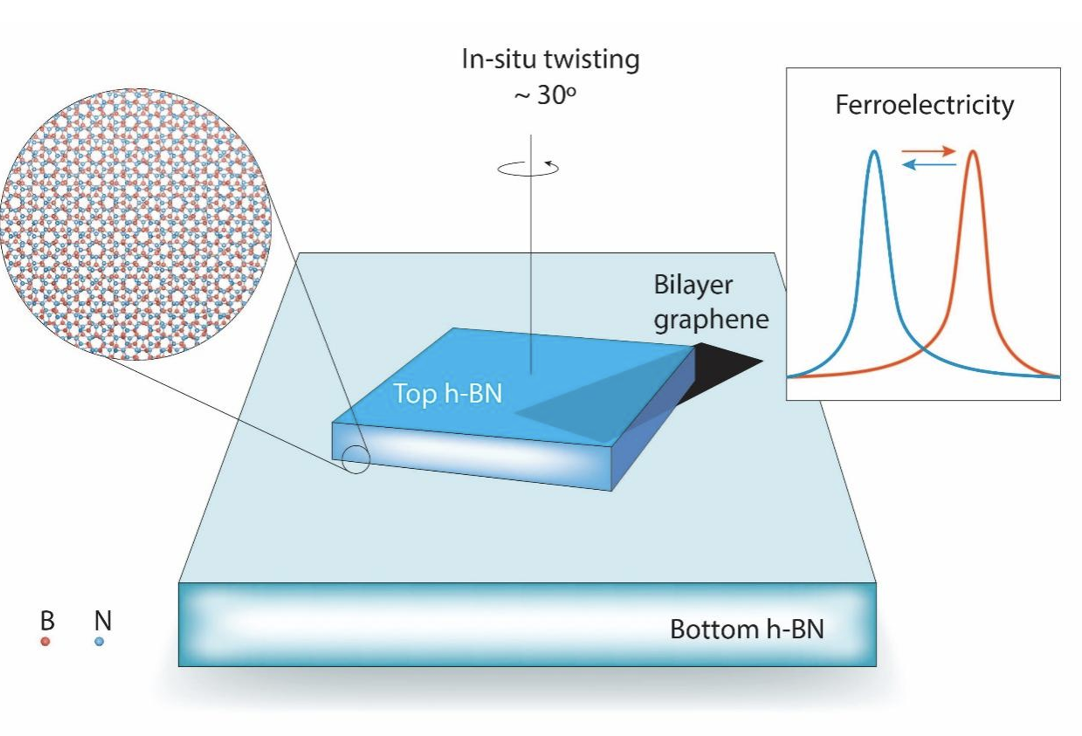
Figure 1 | Schematic of a twist-angle-controlled ferroelectric-like response. The blue components represent the upper and lower layers of hexagonal boron nitride (hBN), while the black component represents bilayer graphene encapsulated by hBN. In situ rotation of the top hBN layer tunes the relative twist angle between the two hBN layers; a twist angle of approximately 30° is shown here. Within an appropriate twist-angle range, the graphene resistance exhibits pronounced hysteresis as the top-gate voltage is swept. The inset on the left illustrates the atomic arrangement at an hBN-hBN interface with a large twist angle, while the curves on the right schematically show the ferroelectric-like resistance hysteresis generated by forward and reverse gate-voltage sweeps.
Article link:
https://www.nature.com/articles/s41563-026-02719-y
- Research Highlights